
Why a Narrowed Tundra Rack Isn’t the Steering Upgrade It Appears to Be


⚠ Before You Spend Thousands on a Custom Narrowed Tundra Rack
Shoppers considering steering upgrades for lifted, large-tire Toyota/Lexus IFS platforms are often pointed toward a custom narrowed 2nd-gen Tundra steering rack as a way to “band-aid” growing steering loads.
While this approach can appear attractive on the surface, it’s important to understand what is actually involved, what it truly costs, and what limitations remain after installation.
TL;DR: By the time a narrowed Tundra rack is machined, installed, and lived with, it costs more, delivers fewer benefits, and is harder to service than upgrading to a true full-size steering system designed around the superior Land Cruiser rack.
What a Narrowed Tundra Rack Conversion Actually Requires
To fit a full-size Tundra rack into a mid-size chassis, a specialty shop must:
- Replace original full-size rack bushings with offset adapters to fit smaller mid-size hardware
- Cut the heat-treated inner rack ends to remove full-size inner tie rod mounts
- Weld in new inserts at a reduced width with smaller mid-size tie rod threads
- Adapt a physically larger rack body to a mid-size steering geometry it was never designed to operate within
- This is skilled machining – but it is also custom and geometry-compromised by necessity
The Real Tradeoffs
Even when executed well, a narrowed Tundra rack conversion comes with unavoidable drawbacks:
- The rack’s centerline and inner tie rod plane are different from stock mid-size geometry
- Knuckle geometry remains unchanged, so steering feel and driving behavior are compromised
- Knuckle steering arms remain mid-size, so steering stress + force remains the same as stock
- Full-size Tundra tie rod interfaces are reduced to smaller mid-size threads
- Reuses mid-size inner tie rods known to buckle & fail with just 285 tires
- Rack-to-frame mounting hardware is reduced from 14mm (Tundra) to 11mm (mid-size)
- No center-mount provision and no double-shear mount options
- V8 applications require additional engine mount spacers
- Replacement racks are custom-order only – downtime and cost can be significant
- No right-hand-drive compatibility (Tundra is North America only)
What It Really Costs
Typical real-world pricing for a narrowed Tundra rack conversion:
- Custom rack: $1,798 avg
- Sales tax: $135
- Shipping: $50
- Installation labor: ~16 hours @ $125/hr → $2,000
- Total: ~$3,983
And this still leaves you with:
- Original mid-size knuckle geometry that is not designed for a Tundra rack
- Original mid-size tie rod & steering rack stress + force
- Original light-duty stock tie rods that fail with just 285s
- Optionally dropping another $1,442 on clevis-style inner tie rods–bringing just your steering system cost into the same range as the full RCLT HD Kit
(see: The Cost of Clevis + Heim-Joint Inner Tie Rod Upgrade)
- Optionally dropping another $1,442 on clevis-style inner tie rods–bringing just your steering system cost into the same range as the full RCLT HD Kit
- Original light-duty single-shear tie rod connection at knuckle
- Original mid-size steering rack mount hardware
- A custom rack that cannot be replaced off-the-shelf or found while out on a camping trip
Additional Consideration: Warranty, Assembly Responsibility & Long-Term Risk
One important factor that is often overlooked with narrowed steering rack conversions is how the rack is modified.
To narrow a full-size Tundra rack, the rack must be completely disassembled so the inner rack bar can be cut and reworked. Once this occurs:
- The original manufacturer warranty is permanently void
- Assembly responsibility transfers from the OEM to the custom shop
- Seal condition and long-term leak resistance depend entirely on the rebuild process
- The rack, even if new beforehand, is now a rebuilt unit
In the steering and hydraulic industry, rebuilt racks — even when assembled carefully — are generally regarded as higher risk than factory-assembled, pressure-tested new units due to additional human processes and variability introduced during disassembly and reassembly.
How This Differs with the Land Cruiser Rack + RCLT HD
With RCLT HD, the 200-series Land Cruiser rack:
- Is installed without being opened or internally modified
- Retains factory assembly, sealing, pressure testing and quality control
- Retains OEM or aftermarket manufacturer warranty
- Customers have made mistakes during install and had their racks replaced over-the-counter at dealerships
This eliminates an entire category of risk associated with rebuilt steering components and preserves the reliability advantages of a brand-new, factory-assembled & factory-sealed hydraulic system.
Why the 200-series Land Cruiser Rack + RCLT HD Is Different
RCLT HD does not attempt to “shrink” a full-size rack into a mid-size system.
Instead, it re-engineers the entire suspension and steering baseline so that a true full-size rack can operate exactly as intended.
With RCLT HD:
- The vehicle is upgraded to full-size steering by design, not adaptation
- A genuine 200-series Land Cruiser rack is used with no internal modification
- Uses engineered full-size steering rack + knuckle + suspension geometry for OE-level driving feel
- Geometry is reset from a lifted baseline for correct alignment + handling at the ride height enthusiasts actually desire (see: Steering Geometry That Works — and Why It Matters)
- Replacement knuckles have full-size steering arms, so steering stress on all components is decreased (see: Our Steering Arms Are Built Different)
- Two-fold benefit: Stronger steering system that also itself experiences less stress
- Steering power is increased at both rack and knuckle steering arm geometry
- Double-shear tie rod connection at knuckle with 1-ton hardware
- Full-size OEM 28mm inner tie rod connection retained
- Full-size OEM inner tie rods are extremely strong and proven undefeated even with 42″ tires
- Full-size OEM 14mm rack-to-frame hardware retained
- Center-mount and double-shear frame mount options available
- Up to six frame mounting bolts and eight full-size shear faces are used (see: Ultimate Rack Mount Upgrades for the Ultimate Steering Rack)
- No engine mount spacers required
- Replacement racks are mass-produced, globally available, and far less expensive
Depending on sourcing, brand-new 200-series Land Cruiser racks range from:
- ~$291 (budget aftermarket options)
- ~$1,086 (Genuine Toyota MSRP [as of Oct 2025], Made in Japan + what we recommend, see: 200-series Land Cruiser Steering Rack for use with RCLT HD)
That represents up to a 6× reduction in rack cost alone, before considering labor, downtime, or long-term serviceability.
The Bigger Picture
A narrowed Tundra rack is often pursued as another step in a long series of incremental upgrades.
RCLT HD was created to eliminate that cycle entirely. (see: The Real Cost of Long-Travel IFS — And the Bargain Hiding in Plain Sight)
Rather than investing thousands into another custom workaround – while retaining light-duty geometry elsewhere – RCLT HD establishes a new engineered baseline that integrates full-size steering, correct geometry, and long-term reliability into a single system.
| Feature / Consideration | Narrowed 2nd-gen Tundra Rack Conversion | 200-series Land Cruiser Rack via RCLT HD |
|---|---|---|
| Steering Philosophy | Custom modification to adapt a full-size rack into a mid-size system | Complete system-level upgrade to full-size steering by design |
| Rack Internal Modifications | Heat-treated inner rack cut and welded to reduce width | No internal modification; rack remains 100% factory-sealed |
| Steering Geometry | Mid-size knuckle geometry retained; rack centerline shifted | Full-size steering geometry engineered into the suspension system |
| Steering Power | Retains smaller mid-size steering arms = higher steering system stress | Full-size steering arms = more steering power + reduced system stress |
| Inner Tie Rod Interface | Reduced to small mid-size threads | Full-size 28mm inner tie rod connection retained |
| Inner Tie Rods | Original mid-size parts; fail with 285 (33″) tires | Large full-size + HD Marlinks = proven even with 42″ tires |
| Rack-to-Frame Hardware | Downgraded to 11mm mid-size hardware | Full-size 14mm hardware retained |
| Frame Mount Strategy | Two-bolt single-shear mounting only | Center mount + double-shear options; up to 6 mount bolts |
| Shear Load Paths | Two small single-shear interfaces | Up to 8 full-size shear faces across multiple load paths |
| Engine Mount Spacers (V8) | Required | Not required |
| Replacement Availability | Custom-order only; long lead times | Over-the-counter worldwide (dealership or parts store) |
| Right-Hand Drive Support | Not available | Available (global Land Cruiser platform) |
| Typical Rack Cost | ~$1,800 (rebuilt custom-machined) | $291–$1,086 (new, mass-produced) |
| Typical Install Labor | ~16 hours | ~4 hours; Installed as part of complete RCLT HD system |
| Total Steering Upgrade Cost | ~$3,900–4,000 Close to $6,000 with tie rod upgrades |
Significantly lower when integrated into RCLT HD No tie rod upgrades needed |
| Long-Term Serviceability | Custom parts, difficult replacement, downtime risk | Simple rack replacement; reuse RCLT HD components |
| Internal Disassembly Required | Yes – rack must be opened and rebuilt | No – installed as factory-sealed unit |
| Manufacturer Warranty | Void | Retained |
| Assembly Responsibility | Custom shop | Toyota / aftermarket manufacturer |
| Long-Term Seal Risk | Dependent on rebuild quality | Factory sealed and pressure tested |
| End Result | Upgraded rack, but constrained by mid-size geometry & light-duty parts | True full-size steering strength with correct geometry and load paths |
To see the full cost and labor breakdown that led to this design approach, read our in-depth article:
👉 The Real Cost of Long-Travel IFS — And the Bargain Hiding in Plain Sight
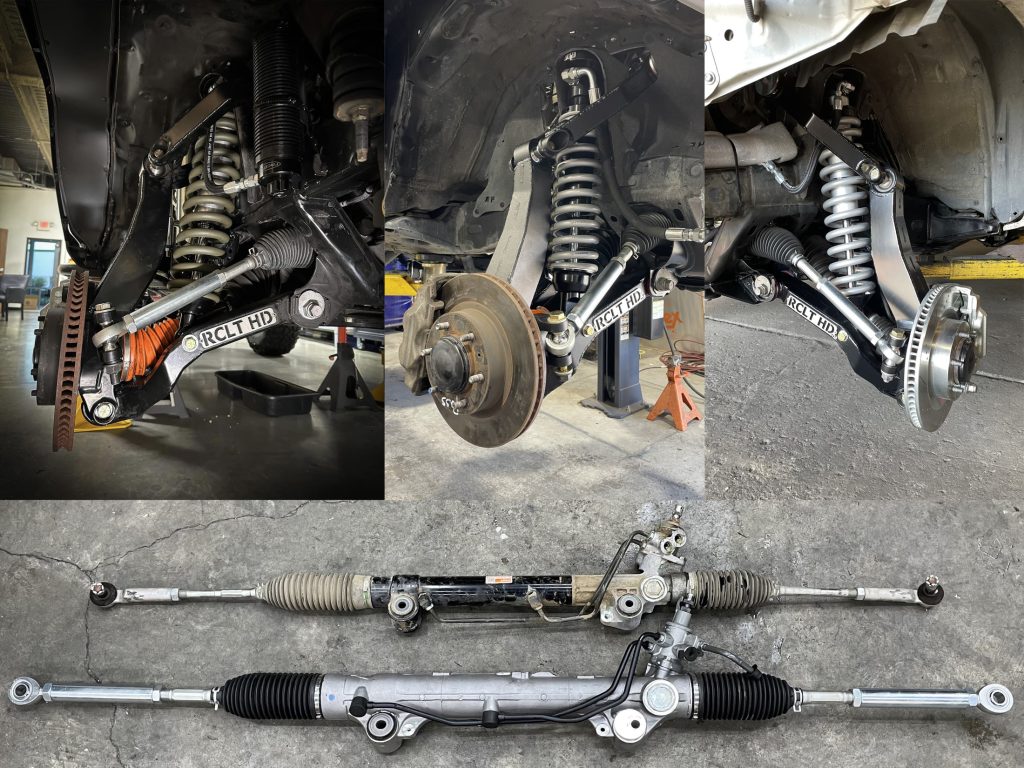
Explore customer images posted to Instagram:
#RCLTHD #MarRack
Post originally featured on our Genuine Toyota 200-series Land Cruiser Product Page.