
RCLT HD > FAQ
Welcome to our Frequently Asked Questions for our Patented RCLT HD Suspension + Integrated Heavy Duty Long Travel IFS Kit
Frequently Asked Questions
Bookmark link: MarlinCrawler.com/RCLTHD-FAQ
• Applications
• Specification
• Install Questions
• BigMike’s Q&A to Dirt Lifestyle’s RCLT HD Install Video
• Type I, II, III, & IV IFS Frame Identification Chart
• Prototyping and Testing
Vehicle Application
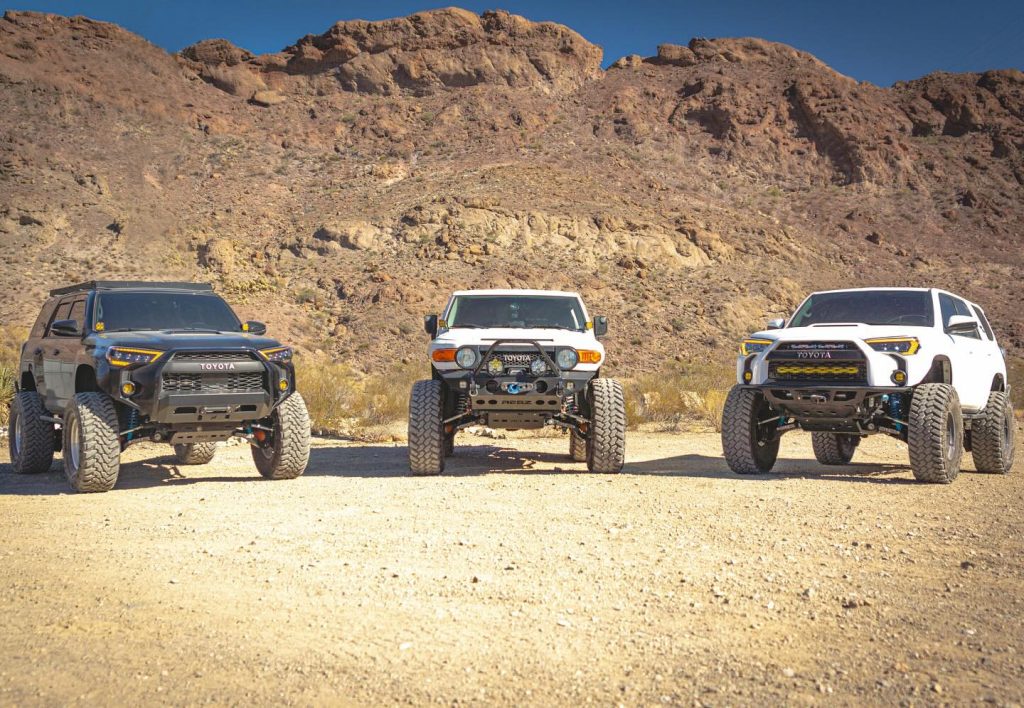
2003-2015 Type III (Prado 120) IFS Platform (all 4WD)
- 2003-2009 Lexus GX470
- 2003-2009 Toyota 4Runner
- 2005-2015 Toyota Tacoma
- 2006-2009 Toyota FJ Cruiser
- Any Right or Left-hand drive Prado 120-type global platform
- May require engine oil pan and/or mount modification
2010-2024 Type IV (Prado 150) IFS Platform (all 4WD)
- 2010-2024 Toyota 4Runner
- 2010-2014 Toyota FJ Cruiser, USDM
- 2010-2024 Toyota FJ Cruiser, Foreign market
- 2010-2024 Lexus GX460
- 2016-2024 Toyota Tacoma
- Any Right or Left-hand drive Prado 150-type global platform
- May require engine oil pan and/or mount modification
Other applications
We receive requests for Type I, Type II, and 100/200-series LC applications. Because the 2003+ Toyota/Lexus mid-size platform is the most common, we began with Type III/IV. For Land Cruisers, sorry but there isn’t enough demand.
Specification
“+2 RC“: Rock Crawling (RC) capability
- Knuckle moved forward +2.00 inches (50.8mm)
- Approach Angle comparable to a mild Solid Axle Swap setup
- No body mount chop or relocation required with up to size 38″ tires
“+2.75 LT“: Extended control arms for Long Travel (LT) capability
- +2.75 inches (69.85mm) longer per side, overall track width increase of +5.50 inches (177.8mm)
- Or +7 inches (139.7mm) wider overall for our +3.50 inch (88.9mm) kit
- Improved side-hill stability, ride quality and smoothness over terrain
- New Mid-length Solution:
- Between industry standard of 2 and 3.50″ widths
- Maneuverability: Being too wide is often detrimental on technical trails (as well as city driving)
- Flex: Horizontal ball joints maximize articulation
- +2.75″ kit achieves up to 14.0″ of travel at the hub, which is 12% more than typical +3.50″ kits yet is 27% more narrow
“HD“: Heavy Duty (HD) Boxed design Including HD Knuckles and integrated HD MarRack Steering Rack
- Maximum strength, durability, reliability, dependability
- Double-shear Horizontal Ball Joints top and bottom with 1-Ton 5⁄8” LCA hardware
- Double-shear 1-Ton 5⁄8” Tie Rod steering hardware
- Extended height knuckle for reduced bump steer and rate of camber change
- Proper Knuckle geometry for lifted applications
- Maintains alignment for a greater range of motion than LT kits re-using stock knuckles
- Better handling and ride quality compared to LT kits re-using stock knuckles
Install Questions
To maximize ground clearance, an RCLT LCA extends horizontally off the frame which constrains bump stop spacing. Using MCSU-761 Low Profile Bump Stop limits total hub travel to 11.6-inches. Taller bump stops, such as DuroBumps’ DBF17T may be fitted to eliminate or reduce fender or cab trimming. Installing custom hydro bump stops will net the full articulation performance of the kit. As of Summer 2023, we now have doubled the bump stop landing area on the LCA for improved bump stop options and mounting versatility. RCLT HD Owners: Click here to view custom bump stop examples.
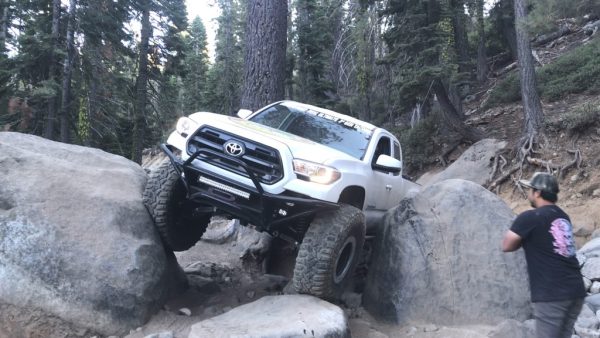 Not designed to be jumped, using factory bump stop brackets |
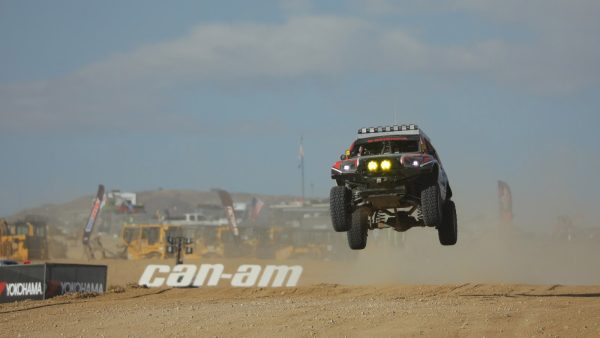 Designed to be jumped, using custom fabricated bump stops |
Due to use preferences from Rock Crawling, Baja, Sand, Mud, Snow, & Overlanding, there is no one-spring-rate-fits-all solution and a vehicle may change spring rates a few times during tuning. The goal for Rock Crawling is to have the F&R suspension complement one another, whereby front spring rate is not too high that it causes the rear suspension to be over-worked.
Keep in mind that leaf springs are a progressive rate spring, therefore a slightly higher front coil rate is recommended to compensate. For custom rear linked setups, we have found success in running quite heavy rear coils. For example, BigMike’s 2016 Tacoma weighs 5,100 lbs and runs 550 lb-ft front coils and a rear 3-link with dual spring rate coils configured as a 100 upper and a 275 lower, with the crossover ring (dual rate stop nut) set to 3/4″ above the dual rate slider. In this configuration, the truck has good compliance for daily driving, and as soon as the rear suspension loads, the higher rate lower coil takes over. This keeps high pressure on the front end resulting in a more active IFS, allowing a front tire to be fully stuffed at the same time as an opposing rear. He is tempted to drop to 500 lb-ft front coils, but given his vehicle weight wouldn’t have enough preload to fit 40″ tires, likely resulting in premature spring bind.
Combining all this and with the understanding that you may eventually alter your spring rates overtime while dialing your suspension in, below is a general guideline table for setting your vehicle up with RCLT HD:
| Use Case | Empty Vehicle Weight | Rear Suspension | Suggested Spring Rate |
|---|---|---|---|
| Rock Crawling | 4,500 lbs | Coil | 500 lb-ft |
| Leaf | 500 or 550 | ||
| 4,500 to 5,250 | Coil | 550 | |
| Leaf | 550 or 600 | ||
| 5,250 to 6,000 | Coil | 600 | |
| Leaf | 600 | ||
| 6,000+ | Coil | 600+ | |
| Leaf | 650+ | ||
| Baja / Sand | 4,500 lbs | any | 550 lb-ft |
| 4,500 to 5,500 lbs | any | 600 to 650 | |
| 5,500+ | any | 650 |
Our horizontal double-shear knuckle connections trade maximum steering angle for maximum strength and suspension travel. We limit steering loss by using each uniball assembly as the steering stop, with staggered-width cups and high clearance misalignment spacers designed to interfere in unison. The result is 4 steering stops per side as opposed to the factory’s one. Our steering stops must be broken-in before maximum turning angle is achieved. Depending on usage, break-in may take a few trail runs to occur. To accelerate process, perform excessive sharp u-turns as well as sharp cornering while articulating the suspension. Below is a table of applications we’ve measured in comparison to RCLT HD.
| Application | Axle Type | # of stops | Steering Angle | Full Sweep |
|---|---|---|---|---|
| RCLT HD, fresh install | IFS (Type III or IV) | 8 | 29° | 58° |
| RCLT HD, broken-in | IFS (Type III or IV) | 8 | 32° | 64° |
| 1998 4WD 4Runner | IFS, Stock (Type II) | 2 | 30° | 60° |
| 2016 4WD 4Runner | IFS, Stock (Type IV) | 2 | 30° | 60° |
| 2021 4WD 4Runner | IFS, Stock (Type IV) | 2 | 29.5° | 59° |
| 2008 4WD Tacoma | IFS, Stock (Type III) | 2 | 36° | 72° |
| Live Axle Comparison | ||||
| Marlin’s 1980 “Crawler Truck” | 8″ Toyota Axle with High Steer | 4 | 28.5° | 57° |
| BigMike’s 1981 Pickup | 8″ Diamond Axle with High Steer | 4 | 31° | 62° |
| 1985 4Runner | FJ80 + Hellfire Knuckles, High Steer | 4 | 30.5° | 61° |
| 1996 FJ80 Land Cruiser | Land Cruiser, Stock | 4 | 32° | 64° |
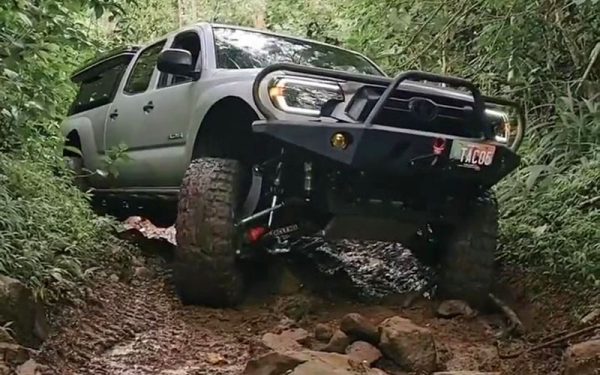

From 2018-2020, we engineered, tested, and patented a geometry-correct near bolt-on system that integrates the oversized 200-series Land Cruiser rack with entirely new knuckles, steering arms, and control arm geometry, making RCLT HD the first and only long-travel IFS kit that fully incorporates a heavy-duty rack designed for a larger vehicle, while maintaining proper mid-size driving dynamics. This includes an updated steering rack mount location being further forward in the frame to match our unique +2″ forward wheel hub geometry.
The result is only 0.5° of combined camber and toe change through 90% of suspension travel for a near-zero bump-steer, which is an exceptional metric in the world of independent suspension, and is one of the reasons RCLT HD tracks straight, corners predictably, and feels factory-smooth regardless of tire size.
Moreover, since all of our customers lift their trucks to clear larger tires, we designed our geometry from that lifted baseline, not stock height. Other Long Travel Kits that reuse factory knuckles can never truly recover proper geometry once the truck is lifted, but RCLT HD delivers correct alignment and steering response at the ride height enthusiasts actually desire. It’s a carefully balanced system of wider steering arms, optimized Ackermann, and adjusted vertical ball-joint separation designed to keep the steering ratio predictable and eliminate bump-steer without forcing customers into oversized 18″+ wheels.
RCLT HD prides itself in having good articulation for its mid-length design. At only 2.75″ wider per side, it achieves 12% more wheel travel than typical 3.50″ kits yet is 27% more narrow for better city driving and maneuverability on technical trails. This is possible because our replacement knuckles use horizontal ball joints instead of stock knuckles that use articulation-limiting vertical ball joints. Alignment Stability is equally important: Our replacement Heavy Duty Knuckles and integrated HD MarRack steering have patented geometry specifically designed for a lift with increased flex, so your alignment geometry does not deflect as much while articulating compared to all other lift kits reusing stock knuckles.
| Maximum Travel at hub centerline with RCV Ultimate Axles | Recommended Limit Strap Setting | Knuckle Geometry designed for a lift | |
|---|---|---|---|
| RCLT HD +2.75″ LT Using Low Profile Bump Stops & RCV axles | 11.6″ | 11.0″ | YES |
| RCLT HD +2.75″ LT Using Custom Bump Stops & RCV axles | 14.0″ | 13.5″ | YES |
| RCLT HD +3.50″ LT Using Low Profile Bump Stops & RCV axles | 12.0″ to 12.5″* | 11.5″ to 12.0″* | YES |
| RCLT HD +3.50″ LT Using Custom Bump Stops & RCV axles | 14.5″ to 15.0″* | 14.0″ to 14.5″* | YES |
| * Our +3.5″ Kit has never been measured and is an estimate The limit for both kits is the in-board RCV joint If installing to a 2WD build or using CVJ Axles, expect +1 to +2″ of more possible Suspension Travel for both kits (CVJ axles only recommended for 33″ or 35″ tires) |
|||
The below video shows measurements of both “Easy” (Options A/B/C) and “Best” (Option D) install methods as per Page 34 of our Installation Guide. Results may vary based on Coilover and Axle type used. See video description for more details.
RCLT HD Owners: Click here to view “Best” method installation tips.
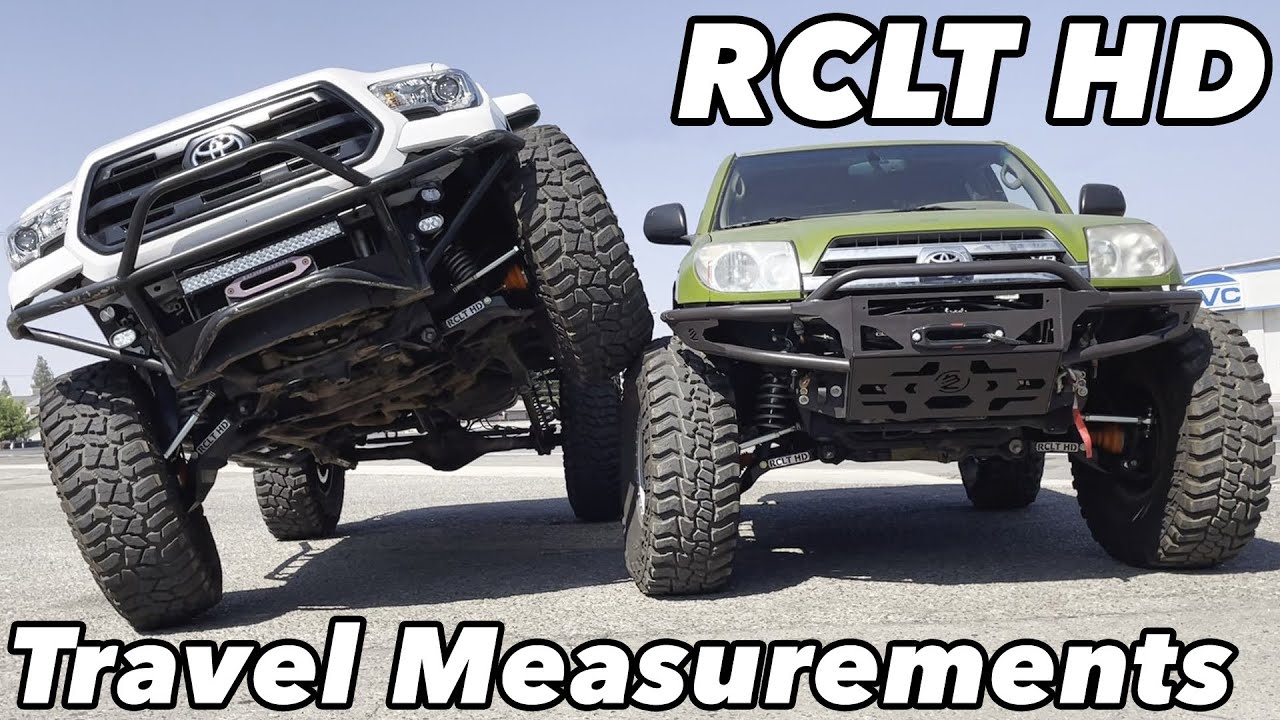
Additionally, while RCV Ultimate IFS Shafts have a lifetime warranty for up to 40″ tires, their outer joints are their very same Dana 60 joints which have a non-breakage guarantee for up to a size 47″ tire. So while their axles are the strongest on the market, realize that while RCLT HD is strong enough for tires larger than 40″, you may violate warranties of other components on your vehicle.
Wheel backspacing should be limited to 4.50″ or less due to the nature of our oversized Heavy Duty Knuckle and wide tires desirable for increased traction (i.e. 12.5″ wide tires compared to 10.5″ stock). Wheels meant for Solid Axle applications typically have around 4″ BS and thrive here. If you are partial to 4.75″ BS wheels, then you could try 1/4″ spacers (example 1, 2) with Extended Thread (ET) lug nuts (example 1) (Amazon links). As for wheel offset, this depends on the width of your wheel. Please use the following to calculate offset (includes industry-standard 1″ wheel mount flange thickness):
Wheel width (in) with Backspace (in) (recommended 4.5 or less) = 0.0 mm Offset
This tool provides an approximate clearance estimate for RCLT HD knuckle fitment using your wheel and tire specs.
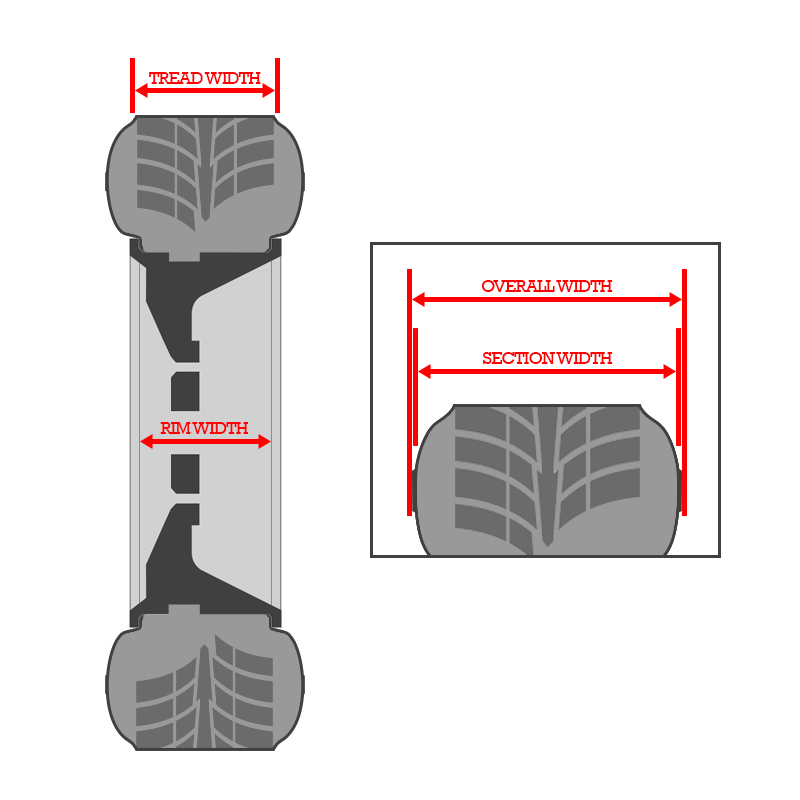
Real-world results vary by wheel design, tire model (true section width, see image), and manufacturing tolerances.
Wheel Specs (6× 5.5in/139.7mm bolt pattern)
Tip: Enter Width + Backspacing or Width + Offset. The other value will auto-calculate.
Tire Specs
Estimated Clearances

Click for larger view
(mounting face → inboard sidewall)
0.70 in clearance
Wheel clearance @ side of knuckle
(mounting face → inner wheel lip)
CAUTION
0.29 in clearance
Wheel centerline position
(from mounting face)
(positive = centerline inboard of mounting face)
Practical Notes: How to Interpret Your Results
Our Heavy Duty Knuckles are intentionally large and robust. For maximum compatibility, we’ve always recommended 4.50″ or less wheel backspacing.
The single most important input in this calculator is your tire’s Measured Overall Width – not the advertised tread width (see this tire width breakdown image). For example, a tire with a 12.50″ tread width may actually measure 13.25″ or wider at the sidewall bulge, especially with aggressive sidewall lugs or when mounted on wider wheels. This example reduces inner clearance by 3/8″ (0.375″) and matters a lot if your calculated clearance is already tight.
PASS (Over 0.50″ clearance)
Your setup is an excellent match for RCLT HD. In this range, you should have comfortable clearance between tire sidewall and knuckle.
This allows for:
- Normal tire flex
- Minor manufacturing variances
- Future tire changes
Many Solid Axle-spec wheels (often ~4.00″ backspacing) fall comfortably into this range.
CAUTION (0.50″ – 0.25″ clearance)
This setup should work – but expect things to be close.
Keep in mind:
- This calculator provides a geometric estimate.
- Tire bulge, wheel width, and sidewall design all influence real-world clearance.
- Future tire changes may be limited.
If you’re in this range, measure carefully and verify after installation.
WHEEL SPACER RECOMMENDED (0.24″ – 0.15″ clearance)
The wheel will likely clear, but the tire sidewall may occasionally scuff the knuckle under load or articulation.
Factors to consider:
- Sidewall lug thickness and inner wheel lip (bead flange) thickness
- Manufacturing tolerances
- Tire oscillation under hard cornering or washboard conditions
In this range, we strongly recommend using thin 1/4″ spacers with Extended Thread (ET) lug nuts (Amazon links) to create a more comfortable margin.
WHEEL SPACER NEEDED (Under 0.15″ clearance)
At this point, the margin is too tight. Even if the wheel technically clears on paper, real-world variables will likely cause contact.
If tire sidewall clearance calculates under 0.15″:
- Expect rubbing during normal driving
- Spacer use is required
- Not recommended without correction
When tolerances are this small, even minor rotor thickness or tire growth variances can eliminate clearance entirely.
Final Recommendation
- Over 0.50″ → Excellent
- 0.25″–0.50″ → Verify carefully
- 0.15″–0.25″ → Spacer recommended
- Under 0.15″ → Spacer required
When in doubt, check with our Forum RCLT HD Owners Club or Facebook RCLT HD Owners Group – users will be happy to share their setup and recommendations with you.
BigMike’s Q&A to Dirt Lifestyle’s RCLT HD Install Video

Below are additional answers by BigMike to video comments from Dirt Lifestyle’s RCLT HD installation.
BigMike: I’d like to first define the term “Long Travel” Long Travel (LT) refers to replacing factory lower & upper control arms (LCA & UCA) of an IFS with new arms that are longer than stock. There are much longer LT setups in the world, from Ultra4 to Trophy Trucks, where the LCAs are inboard-mounted close to one another for maximum arm length. But arms from a “LT kit” attach directly to your existing frame mounts as a simple remove-and-replace install. As the arms are longer, we get more suspension travel, articulation, stability, and an improved ride, but at the expense of adding overall width to the vehicle. It’s a compromise: Really long arms are great for performance, but the vehicle becomes excessively wide and difficult to drive in cities and narrow 4WD trails. In addition to more flex, longer arms extend further down for the same arm angle providing natural lift without incurring excessive CV joint and steering component angles. This is how we’re able to get more lift instead of using a Frame Drop Bracket Kit which negates the ground clearance advantage of IFS.
Q: When will RCLT HD be available? A: Kits have been shipping since Spring 2021.
Q: What does RCLT HD fit? A: Type III & IV Toyota IFS frames (2003+ 4Runner/Lexus GX, 2005+ 4WD/PreRunner Tacoma, 2006+ FJ Cruiser).
Q: What makes RCLT HD different from other Toyota LT kits? A: RCLT HD has created a new market segment and does not directly compete with existing LT kits. Specifically, RCLT HD is the first LT kit designed for Rock Crawling and provides unmatched approach angle, ground clearance, and steering strength. Some of its “firsts” include: (1) First LT with an integrated replacement HD steering rack built with 1-Ton double-shear components providing more steering power & reduced driver fatigue, proven strong enough for King Of The Hammers (KOH) and 40″ tires, (2) First LT to incorporate two-inch forward-mount knuckles, whereby a 35″ tire easily clears the body mount frame bracket, 37s fit like 33s, and up to a size 42″ tire may be installed without relocating the body mount, (3) First LT to incorporate an inverted lower arm with inset shock mount equaling the ground-clearance gain of going from 31 to 40″ tires, (4) First LT strong enough for Rock Crawling, and (5) First LT that challenges the benefits of a Solid Axle Swap (SAS).
The fact “SAS” is even listed on this product page tells you all you need to know.
Q: What frame modifications are required compared to other LT kits? A: RCLT HD requires a steering rack insert to be welded into the frame.
Q: What skills and equipment are needed to install RCLT HD? A: “If you can drill a hole and weld upside down, you can install RCLT HD” – Nate, Dirt Lifestyle
Q: How long does it take to install RCLT HD? A: The experienced mechanic may install RCLT HD in 8 to 12 hours and the first-time home-mechanic should be able to do it in two weekends. Expect an average shop install time to be 2-3 days.

Q: What are the advantages of RCLT HD over an SAS? A: While RCLT HD was never meant to replace an SAS, it challenges the benefits of an SAS by having vastly more ground clearance, less unsprung mass, is 99% bolt-on, may be removed & transferred vehicle-to-vehicle (ex. if you have a Tacoma now but later switch to a 4Runner), retains factory speedometer/ABS/cruise/traction control systems, no death wobble, reuses original brakes & hub components for ease of service & parts sourcing, can be aligned by any shop without special instructions, and retains superior IFS handling, ride-quality, & stability for daily-drivers.
Q: How does installation of RCLT HD compare to an SAS? A: Shops typically schedule 2 to 2½ weeks to SAS a Type III/IV frame, whereby RCLT HD can be installed in a couple days. Moreover, the average home mechanic able to install a LT cannot build a custom late-model SAS.
Q: How does the price of RCLT HD compare to an SAS? A: SAS’ing a late-model Toyota IFS cannot be compared to SAS’ing a 1986 Hilux. Many shops charge $25,000 or more for a turn-key SAS which is more than double a turn-key RCLT HD. When installed at home, a complete turn-key RCLT HD costs less than just an SAS labor charge. If you’re unable to install RCLT HD yourself, expect a 2-day shop labor charge to be just over $2,000.
Q: Why is it you didn’t want to remove the IFS in favor of a solid axle swap but in the same breath you tore the rear suspension out to go linked and coilovers? A: Keep in mind that a rear SAS does not require removing the two strongest cross members of the frame (IFS sub-frame), removing existing shock towers, adding at least two new crossmembers (radiator support and under the bellhousing), changing to an entirely new steering type (gear box) with matched panhard-to-tie rod angles, and avoids all the complications of packaging new hydraulic lines, pan hard bar, upper tower & link, and taller shock towers under and around the engine oil pan, exhaust manifolds, and cylinder heads as well as clearancing into the cab and front wheel well which is much more limited and time consuming than simply removing inner fender plastic from the truck bed. As Nate shows, a 3-link conversion to an existing rear solid axle without any engine and steering complications is easier than a front SAS, and he even reused the factory rear leaf spring hangers and avoided cutting the frame entirely! Case in point, shops can do rear 3-links like Nate’s in 2 days whereas an SAS to a late-model Toyota can take up to 3 weeks.
Q: What makes RCLT HD cost more than typical LT kits? A: Simply put, RCLT HD has the most massive and strongest Toyota LT replacement knuckles ever made. This is because our HD Knuckles are made from one-piece solid steel lower sections, where the brake caliper mount, hub, and double-shear steering arm are all one interconnected solid part. This billet chunk of steel starts out at 50 pounds and is both larger than the billet we use to make our MC08 Dual Case Adapters and requires nearly twice as long to machine. In addition, we use 1/4″ plate steel instead of 3/16″ and have extra front & rear double-wall plating where stress forces are the highest. When you consider how each knuckle requires more manufacturing than a Dual Case Adapter with additional laser cutting, forming, assembly, welding, and powder coating, you can see how each knuckle is valued at $1,500. Without the knuckles, our retail price would be $3,999, which is on-par with typical LT kits despite our kit also having double-shear HD upper arms with 1/4″ steel plating, double-shear HD lower arms with 1/4″ steel plating, and parts to build and install a replacement HD MarRack with DOM MiniMarlinks, 1-Ton 5⁄8” tie rod ends, and patented steering geometry. (Most all LT kits use single-shear connections, only 3/16″ plating, and are not an integrated HD steering rack upgrade.) Comprised of 248 parts, RCLT HD is the most complex LT kit by a wide margin and I believe it is reasonably priced for what it offers: The strongest and most reliable LT kit ever made with Rock Crawling ability no other LT kit can hold a candle to.

Q: What is the MarRack? A: The MarRack is an oversized heavy duty steering rack used exclusively with RCLT HD. Originally, we sought to make our own custom Heavy Duty steering rack, however, after working with both Koyo Seiko and JTEKT direct in Japan it was impossible to compete with the low cost of simply modifying an existing rack. So instead, we evolved RCLT HD to work with a Land Cruiser rack which is modified into a MarRack. All parts are transferable so should you ever need a new MarRack you simply grab an over-the-counter LC rack, convert into a MarRack, and install! See Required Parts tab for more details.
The name “MarRack” is derived from Marlin’s traditional nomenclature dating back to the mid-1980s where he invented the MarTack (prevents locker damage at time of axle failure), Marlink (first heavy duty replacement steering tie rod), Marfield (first heavy duty replacement Birfield axle joint), MarJoint (rebuildable uniball), and the 22MAR (one of the first 20/22R engine builds).
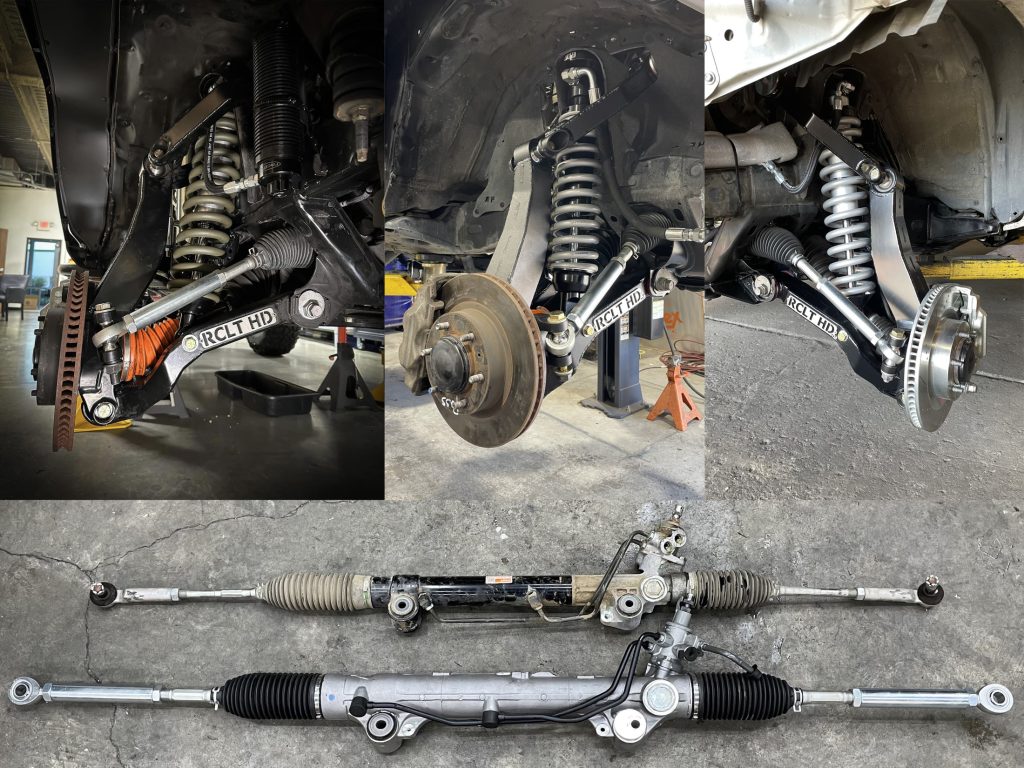
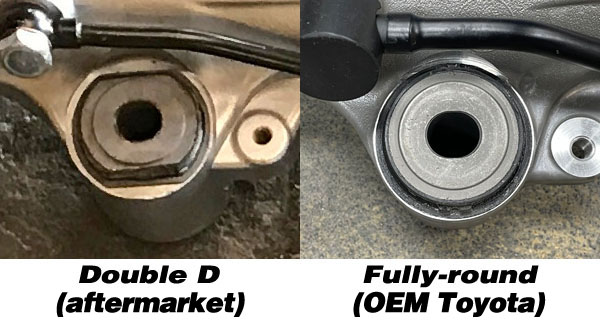
NOTE: Due to inferior bushing design and inconsistent high pressure line fitting tolerances, we no longer recommend new-aftermarket or re-manufactured racks, especially if they have double D bushings. Please see this image for reference.

Top: Factory light-duty steering rack. Bottom: Marlin Crawler MarRack with DOM MiniMarlinks & 7/8-14 X 5⁄8” TREs
Q: How strong is the MarRack? A: The MarRack is the only DOT-approved steering rack to survive KOH as well as more than 70,000 miles of daily-driving and rock crawling across six-states with 40″ tires, Triple Transfer Cases (580:1 Crawl Ratio), F&R lockers, cutting brakes, & never trailed. It has three frame mounts instead of two with M14 mount hardware instead of M12 (2.1 X stronger frame connection), mounts are wider than stock for greater force loading, uses M28 ITRs instead of M14 (4.0 X stronger connection), and is built from a one-piece oversized aluminum housing that is 54% more massive than stock. On top of all this, our HD Knuckle steering geometry reduces load upstream to steering components, so every trail object the MarRack “feels” is reduced by our patented design.
MarRacks have been in use for over half a decade with 35 to 42″ tires and have had no reported rack or tie rod failures.
Q: Can the MarRack be used with stock IFS or other LT kits? A: No. Because the MarRack is derived from a Land Cruiser, which is wider than the mid-size SUV/Tacoma, a new steering, knuckle, and suspension geometry is required for it to work safely & properly. I spent over two years perfecting this geometry to be stable throughout 14-inches of travel and patented the design allowing an oversized rack to work in narrow frames.
Longer answer: From a safety standpoint I am compelled to express further that mismatching IFS geometry may cause injury or property damage as vehicle control is a critical safety aspect that MUST be taken deadly serious.
The narrow mid-size frame width (Tacoma/4Runner/FJ Cruiser/Lexus GX) is NOT compatible with a wider Land Cruiser steering rack. That alone throws off steering geometry. But it’s worse: The MarRack sits further forward and higher up in the frame than your stock rack. This incompatible combination results in a host of issues including bump steer, excessive cross-caster, increased brake-dive, and cornering instability. Additionally, your knuckle geometry does not match a Land Cruiser rack so you get a large slip angle (Ackermann) and a lower steering ratio resulting in twitchy steering, dangerous emergency lane changes, and a greater risk of highspeed roll-over. The cherry on top will be excessive front tire wear.
The wider Land Cruiser geometry does not match narrow mid-size applications
The steering system of an IFS is more complex than a Solid Axle and one cannot throw random parts together, tighten shackles to quiet death wobble, and head for the trail. On an IFS, your tires are connected to lighter, more efficient components with built-in dynamic caster & camber that affect toe, so incorrect geometry is more detrimental to driving dynamics than a solid axle. IFS requires careful design to properly integrate with an entirely different steering system. When I first installed a LC rack in 2018 it handled so poorly that I could not go over 40 MPH and almost caused an accident. There is a reason why this had never been done before.
If simply throwing in a MarRack worked and was safe then we would have patented it
For these reasons we do not build our HD Knuckles with reusable jigs in non-temperature controlled rooms, welding together thin plates of steel into hallow steering arms that customer lives depend on. The excellent drive & handling of RCLT HD comes from our HD Knuckles’ one-piece solid billet double-shear steering arms (the first Toyota LT of its kind) with CNC-precision mirror-matched geometry creating the first LT kit geometrically integrated with an oversized steering rack from a larger vehicle.
RCLT HD is the first LT kit with a geometrically integrated oversized steering rack
The result of our patented geometry-stable design is driving characteristics better than any LT kit that reuses stock steering geometry in a lifted application. Customers praise how tight and responsive RCLT HD’s steering feels, and a Grandmother could daily-drive RCLT HD with 40″ tires and would not need a list of precautions.
RCLT HD’s stable geometry has up to 14″ of hub travel (+2.75″ kit) that experiences only half a degree camber & toe change through 90% of flex
This is impossible with stock knuckles and a LC rack Our stable geometry from lift-to-squat results in an exceptional driving experience
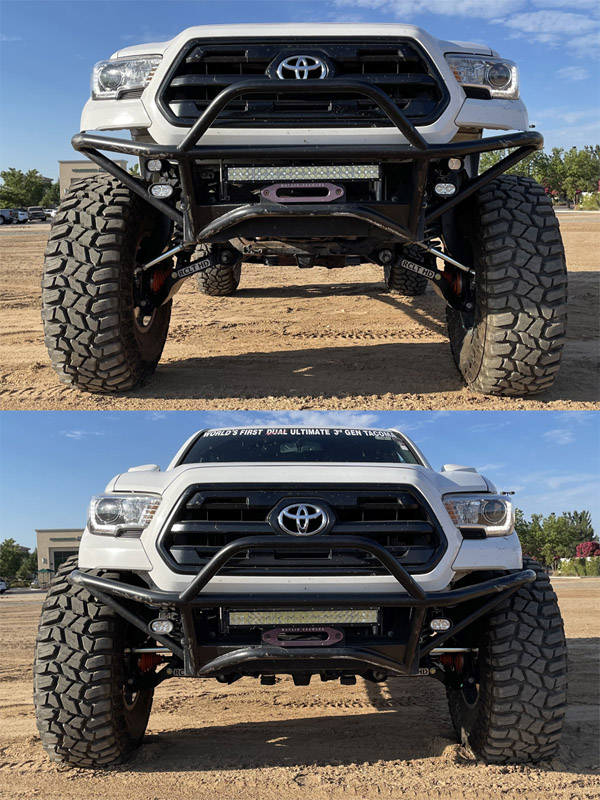
Q: Do we offer the MarRack? A: UPDATE 11/21/2023: Yes, we do! Please visit our 200-series Steering Rack product page for details. Please note that because there is no way we can ensure the installer properly flushed the steering system in order to warranty a MarRack, once the rack has been modified or installed, we are unable to accept it as a warranty or return as we also would not be able to return it to Toyota. Please see the Disclaimer on the product page for more details.
Q: Any power steering pump mods required? A: No. Our steering geometry increases steering strength, so an increase in pump pressure or cooling is not needed.
Q: Aren’t other LT kits used for Rock Crawling? A: While you could go rock crawling with other kits, none are designed for it. It is well accepted that a 35″ tire is the minimum entry size to be taken serious as a Rock Crawler, and because factory inner tie rods fail with 33s, knuckles bend with 34s, and steering racks die with 35s, there is no Rock Crawling LT kit. In fact, other LT manufactures advise against technical rock crawling altogether. We are not only confident in technical Rock Crawling RCLT HD with tires up to and including 40″, but our patented design provides SAS-like approach angles, increases ground clearance beyond other kits, and has steering and knuckle strength proven strong enough for KOH underneath 4.7L V8 4Runners. We are achieving this with non-upgraded factory MarRack inner tie rods (ITR) and have yet to bend or break a single one, even with 40s. RCLT HD is in a league its own when it comes to IFS Rock Crawling capability and performance.
Q: What’s the point of all this strength when you’ve still got the front IFS differential? A: We covered this from the 19:55 to 22:01 min video mark, but another thing to add is that the reverse-rotation high-pinion 8″ Type III/IV IFS differential uses the same R&P from the 100-series 4.7L V8 Land Cruiser, which is the same R&P as the venerable and popular 80-series High Pinion except it’s even stronger due to it having a wider & thicker ring gear. So the SUV/Tacoma 2003+ front IFS differential is (1) stronger than the Toyota Solid Axle 8″ High Pinion, (2) is from a V8 Land Cruiser, and (3) has well been proven strong. The strength or reliability of my front diff has never crossed my mind throughout my entire 70,000 miles of daily driving and Rock Crawling with the same front diff, a 580:1 Crawl Ratio, and 40″ tire/wheel combo that weighs 145 lbs each.
Q: Can RCLT HD be used for High Speed? A: Absolutely, as proven at KOH. However, please bear in mind that our design is optimized for rock crawling strength & performance. Therefore, (1) our parts are heavy which reduces high speed efficiency and (2) because our lower arms are optimized for ground clearance, the CV boot will contact the lower control arm at full droop. See Instructions | Appendix A13: “High Speed Use Tips” for more details.

Q: Can RCLT HD be installed onto a non-USDM Hilux/Surf Toyota vehicle? A: So long as the vehicle shares the same Prado 120/150-series IFS, then there is a good chance it can. Also, the MarRack can be made for LH or RH configurations. The only unknown variable is space beneath non-USDM engines such as turbo diesels, so oil pan modifications may be required to clear the oversized steering rack.
Q: Can I use a Big Brake Kit on RCLT HD? A: Customers have successfully installed oversized Wilwood, CEIKA, and OEM brakes with RCLT HD. I run oversized Lexus GX460 brakes on my Tacoma. It is known that 6-piston AlconUSA and StopTech brackets must be modified for speed sensor and knuckle upright fitment. RCLT HD Owners: Please see this thread for more info on aftermarket brake kit compatibility: Big Brake kit
Kits shipped since summer 2022: Our HD Knuckles now use Toyota’s larger M14 caliper hardware found on 2015 and newer SUV applications. This means 2014 and older SUVs and all Tacoma applications will need to order 4× larger caliper bolts (product page) and upgrade existing caliper through-holes using a 9⁄16” drill (Amazon search). Each caliper flange has a lot of surface area and drilling one size up has no impact to safety or brake performance. (Optionally, you may choose to upgrade to larger 08/2013+ 4Runner/GX460 M14 calipers with matching 08/2010+ 4Runner/GX460 rotors for an OEM “Big Brake” setup.)
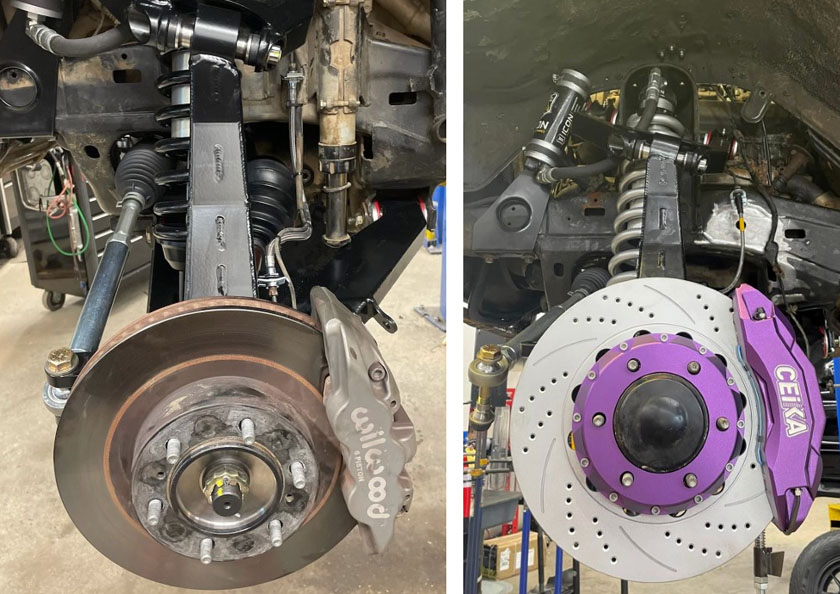
Six-piston Wilwood and CEIKA brake upgrades with RCLT HD
Q: How much travel to expect from RCLT HD? A: This depends on how much up-travel you’re looking to have, pending tire size and clearancing plans (see “Bump Stop Consideration” Page 34 of our Online Instructions). For example, on Nate’s +3.50″ setup, he is intentionally limiting up-travel to minimize 38″ tire clearancing requirements, and is only expecting about 12″ of travel. On my shorter +2.75″ setup, I get 14″ of travel at hub centerline because I relocated my bump stops. This is why we did not cover this in the video because Nate is not sure how things will turn out pending his fiberglass fender install. He has a lot more down travel than I do so if he did the same amount of clearancing as I did then I’d expect him to have around 16″ of travel.
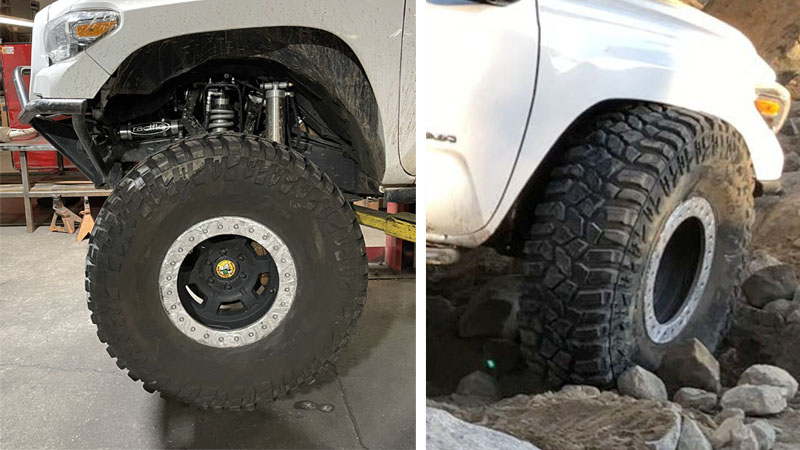
RCLT HD (+2.75) achieves up to 14″ of travel at the hub. Click here for more info
Q: How close are the 2nd & 3rd gen Tacoma front suspensions? A: See Appendix A6 of RCLT HD’s Installation Guide.
Q: Are factory and aftermarket skid plates compatible with RCLT HD? A: As far as we know all skid plates, stock and aftermarket, are compatible with RCLT HD. Update 8/3/2022: Skid plates that utilize the M12 bolt hole in front of the factory steering rack’s LH frame mount may require modification to work.

Q: How long will the uniballs last? A: While uniballs do not last as long as sealed joints, I did not want to settle on anything less than the ultimate strength of double-shear top-and-bottom mounts which means uniballs are the only option. How long they last depends on mileage and climate type. For daily driving in dry climates, expect them to last 5 years or more. For daily driving in cold climates where road treatments like salt are used, we’ve heard they may only last up to 1 year. We use 1″ high quality USA-made FK Uniballs. Rebuild kits are currently available by phone.
Q: Do you have to relocate headlights in order to run 40″ tires? A: When I allowed my TacomaWorld forum thread to get hijacked last year, some user who has never ran a LT with 40s claimed I relocated my headlights in order for this to work. He is mistaken as I run my 8″ Radflo shocks (p/n 6CT-001-5A) to full compression and all my components are in their stock location, including headlights and battery.
Q: How is the ground clearance comparison fair when Nate’s Tacoma is on jack-stands? A: Nate can easily set his ride height to match what’s shown, and also the Jeep is on taller 39″ tires while the Taco is only on 38s!!
Q: Will Nate’s truck be at the 2022 KOH? A: Hopefully yes and come see it & meet Nate in person at our Marlin Crawler booth!
Q: How did Mike like Nate’s coffee? A: It was delicious and was served in a stainless tumbler with “Dirt Lifestyle” logo!

RCLT HD with 40×13.5″ tires under a 2016 V6 Toyota Tacoma
More than 70K miles of testing with 40s and zero steering, axle, or differential failures
North American IFS Types for Toyota Mid-size Pickups and SUVs
To help understand the differences of the Toyota IFS 4WD, please see the following section which comes from our Instructions, Appendix A6.
| IFS Type I 1986-1995 | IFS Type II 1995-2004 | IFS Type III 2003-2015 | IFS Type IV 2010-2024 | |
|---|---|---|---|---|
| RCLT HD Compatible: | No | No | YES | YES |
| Applications: | 1986-95 Hilux 1986-95 4Runner | 1995-04 Tacoma 1996-02 4Runner | 2003-09 4Runner 2003-09 GX470 2010+ GX460 2005-15 Tacoma 2006-09 FJ Cruiser |
2010+ 4Runner 2010-14 FJ Cruiser 2016+ Tacoma |
| Spring Type: | Torsion Bar | Coil over | Coil over | Coil over |
| Differential: | Standard | Standard | Clamshell | Clamshell |
| R & P Size: | 7.5″ | 7.5″ | 8.0″ | 8.0″ |
|
Rotation:
|
Standard | Reverse | Reverse | Reverse |
|
Source:
|
1979 2WD Pickup | Land Cruiser Prado 90-series | Land Cruiser (V8) Prado 120-series | Land Cruiser (V8) Prado 120-series |
| Steering: | Gear Box | Rack & Pinion | Rack & Pinion | Rack & Pinion |
|
Location:
|
In front of axle | Behind axle | In front of axle | In front of axle |
| Outer CV: | Bell OD: 93mm Splines: 26 | Bell OD: 94.5mm Splines: 30 | Bell OD: 106mm Splines: 30 | Bell OD: 106mm Splines: 30 |
| Inner Shaft: | OD: 23.75mm | OD: 29mm | OD: 32mm | OD: 32mm |
| Hubs: | Manual or Automatic | Manual or Non-selectable | Non-selectable | Non-selectable |
| Brake Rotor: | OD: 289 to 291mm Thick: 20 to 25mm | OD: 296 to 319mm Thick: 22mm | OD: 319 to 338mm Thick: 28mm | OD: 319 to 338mm Thick: 28 to 32mm |
| LCA Design: | Hilux | Land Cruiser Prado 90-series | Land Cruiser Prado 120-series | Land Cruiser Prado 150-series |
|
Bump stops:
|
2 per side | 2 per side | 1 per side | 1 per side |
Marlin Crawler’s Take
Type I: The first 4WD IFS offered in the States left a lot to be desired. The use of a torsion bar limited lift options and resulted in a squeaky off-road experience. While it used a traditional and robust steering box, the idler arm and small tie rods were prone to failure. Small axle shafts with no HD Rock Crawling upgrade options, and a small front R&P lifted from a 1979 2WD pickup.
Largest recommended Rock Crawling tire size: 32″.
Type II: The Prado 90-series was a major upgrade for IFS 4WD Toyotas. Designed by Toyota’s commercial truck division Hino Motors, this IFS features easy to change coil overs, axles with available HD aftermarket upgrades, improved reverse-rotation high-pinion R&P, and a steering rack mounted favorably behind the axle for improved forward-direction strength, it had potential.
Largest recommended Rock Crawling tire size: 33″.
Type III: The Prado 120-series IFS essentially doubled the strength of Type II in every category except steering. The differential became larger and adopted an improved clamshell design which orientates assembly bolts perpendicular to the pinion resulting in much greater pinion deflection resistance. The R&P is the same used in the larger 8cyl 100-series Land Cruiser and proven reliable with 40″ tires. Heavy Duty aftermarket axle options include inboard & outboard 35-spline Dana-60-sized CV joints that include a manufacture guarantee to not fail with tire sizes up to 40″ in diameter.
Largest recommended Rock Crawling tire size: 35″ with proper attention to steering & knuckle strength.
Type IV: The Prado 150-series IFS further builds upon the Type III by featuring larger and stronger lower control arm mounting hardware. In some SUV applications, the brake rotors are 6% larger and 28% thicker, and calipers have 28% more piston area with 36% stronger knuckle mount hardware. Steering strength unfortunately remains the major weak-link of the mid-size Toyota IFS.
Largest recommended Rock Crawling tire size: 35″ with proper attention to steering & knuckle strength.

Prototyping and Testing
RCLT HD has come a long way since we began testing and building in 2018. RCLT HD customers have successfully ran these trails plus many others country-wide, including trails in Japan.
Below is a list of trails we’ve tested RCLT HD with up to 40″ tires with zero failures during prototyping:
|
Northern California:
Central California:
Colorado:
Southern Utah:
|
Moab, Utah:
|
Southern California
|
